You can do the moves.
In live rolling you can't find them.
Every white belt has the same list: forty techniques you've been shown, and three you actually hit. The problem isn't memory — it's that you wrote down moves when what you needed was the map between them. BJJ Sequence is a notebook shaped like your game: one card per technique, chained into the routes you actually use.
You already know this feeling
- You drilled a sweep on Tuesday. Friday's roll comes and it never occurs to you.
- Your notes app has 40 techniques in a flat list. A list can't tell you what follows what.
- You keep ending up in the same bad spot and you've never actually decided what to do from there.
- Three months later you remember the name of the move but not the one detail that made it work.
How it works
Three things, and the third is the one you can't get from a notebook.
One card per technique
A position, the details your coach actually said, and photos. Takes about a minute after class — which is all the time you have.
Chain cards into routes
From de la Riva, to the sweep, to the pass, to the finish. Don't know a step yet? Leave it blank — the gap is the useful part.
The graph finds your holes
Positions you keep arriving at with no recorded way out. Routes you built but never drilled. Things you'd never have spotted reading your own notes.
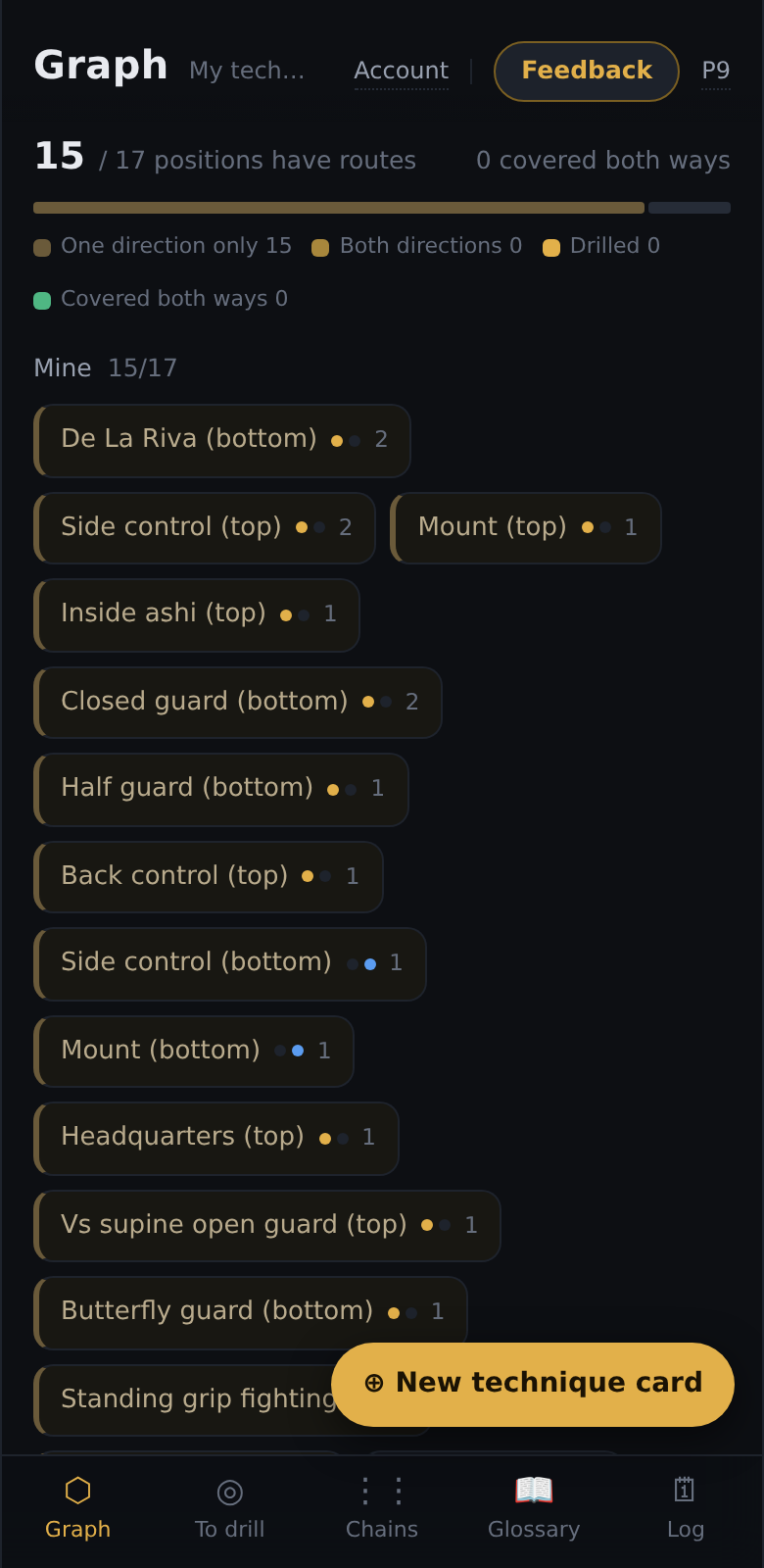
Your graph. Each card lights up as routes run through it. Two dots = offense and defense covered.
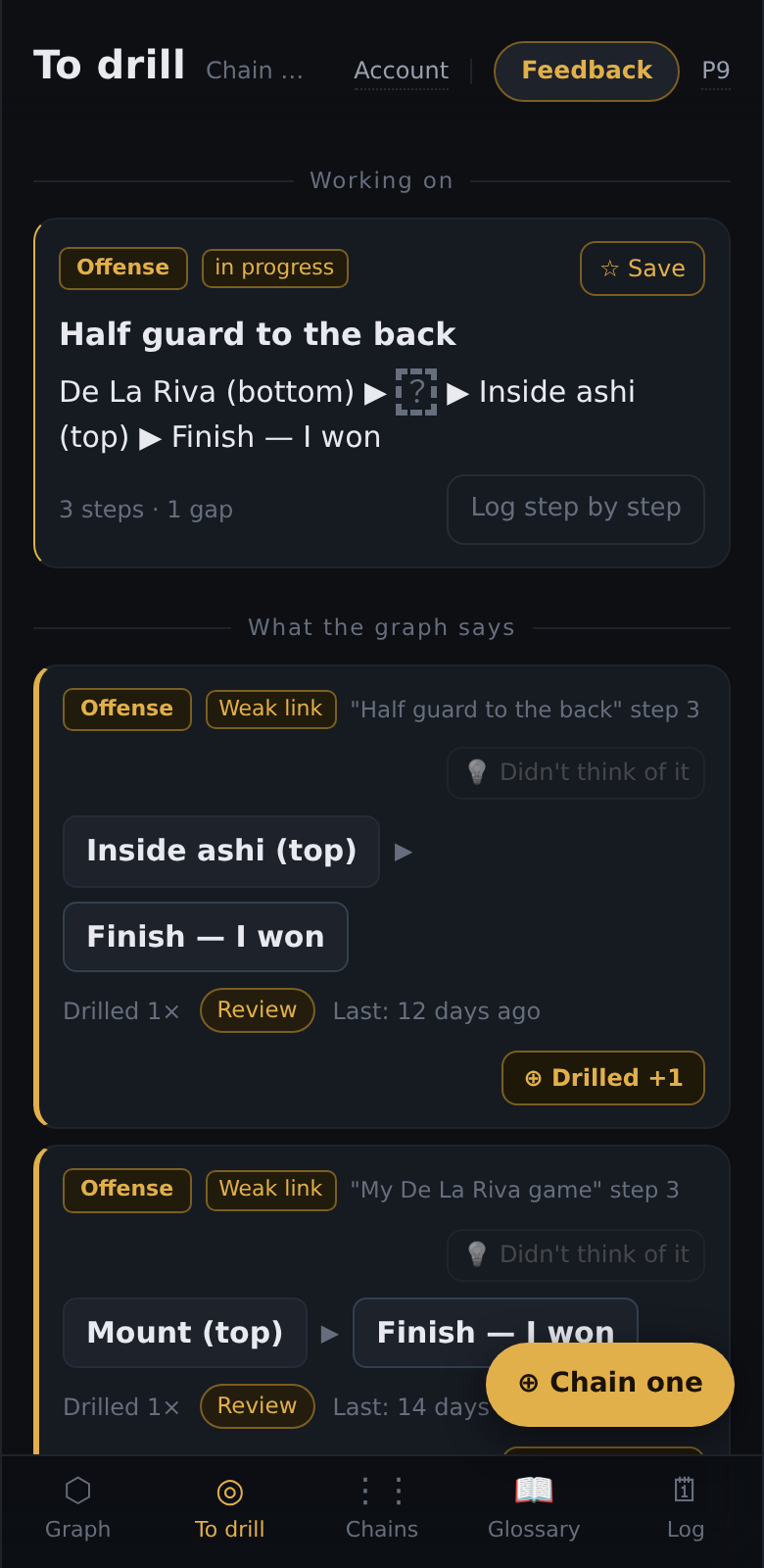
What the graph says. Blind spots and weak links, computed from your own cards — not a generic curriculum.
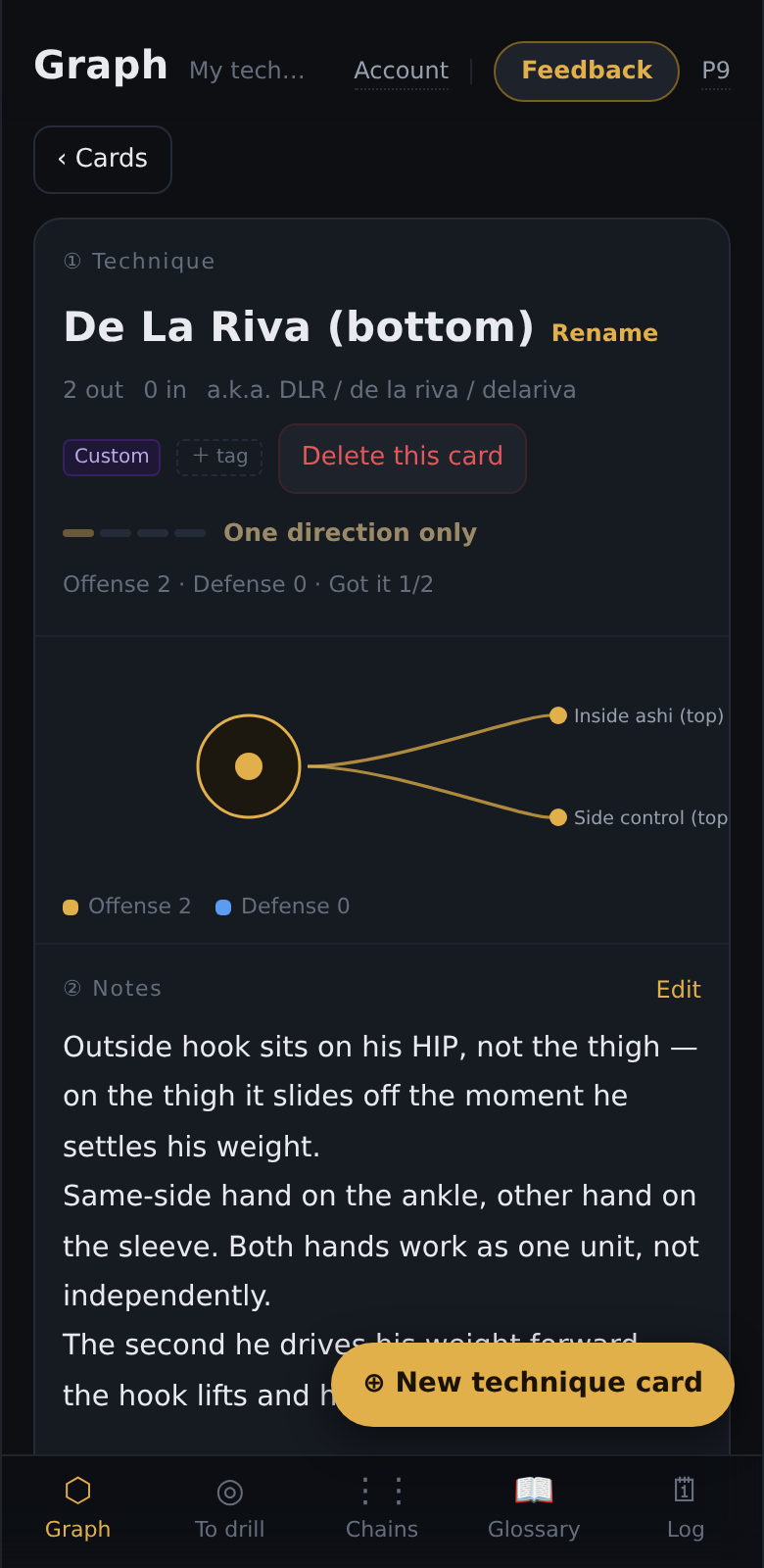
One card. Your details, your photos, your name for it — and every route in and out.
What it isn't
Not an instructional library
There are no technique videos to watch. Everything in here is something you recorded after your own class.
Not a social network
No feed, no followers, no sharing. Your graph is yours and nobody else sees it.
Not a fixed curriculum
You name the positions. If your gym calls it something else, or you have three variations of the same guard, the app follows you — not the other way round.
Price
Try it for real before you pay. No card, no trial timer.
- 3 technique cards
- Chains and routes
- Photos on your cards
- Export everything, any time
- No video
- Unlimited technique cards
- Sync across your devices
- Text and photos on your cards
- Video is a separate plan, coming later
- Export everything, any time
Secure international checkout with cards, Apple Pay, Google Pay and PayPal is being connected. Create your free account now; the first-100 price will be reserved when checkout opens.
Start with 3 free cardsStraight answers
Where does my data live? Everything you write is stored on your phone first, so the app keeps working in a gym with no signal. Your signed-in account also syncs cards, notes and photos to my server so you can pick up on another device.
Can I get my data out? Yes, and I'd rather you could. One button exports everything — notes, cards and media — as a zip, with your photos sorted into a folder per technique. One button deletes everything I hold about you, permanently.
Who's building this? One person, a white belt training three or four times a week, who got tired of a notes app full of moves he never used. It's built in the open and it's early — you'll find rough edges, and the Feedback button goes straight to me.
Is the reference content reliable? The glossary of positions and common options is a starting scaffold compiled from public sources and not expert-reviewed. Treat it as a prompt, not as instruction. Your own cards are the source of truth.
Start with the last position you got stuck in
Make one card for it. Then one for what you tried. That's already a route.
Open BJJ Sequence